
Module · Live
Change Management: run ADKAR and Kotter programs without the spreadsheets
ADKAR and Kotter execution, with the spreadsheets removed. Stakeholder matrices, resistance logs, and training plans you can actually act on — coached by AI that has seen what works.
Stakeholder matrix
Power × interest grid with engagement state. Track who needs what message, when, from whom.
Resistance log
Capture concerns in context, route to owners, close the loop. The change history that survives turnover.
Training plan
Role-aware training paths, cohort tracking, and completion analytics. Linked back to the ADKAR stages.
AI change coach
Pattern-matches your engagement against Atlas. Surfaces interventions that worked on similar rollouts.
In short
What Change Management does
Change Management is where you plan and measure the people side of a rollout. You map stakeholders, score their readiness with the ADKAR model, track Kotter's 8 steps for the program, and manage resistance, training, communications and rollout waves for each initiative.
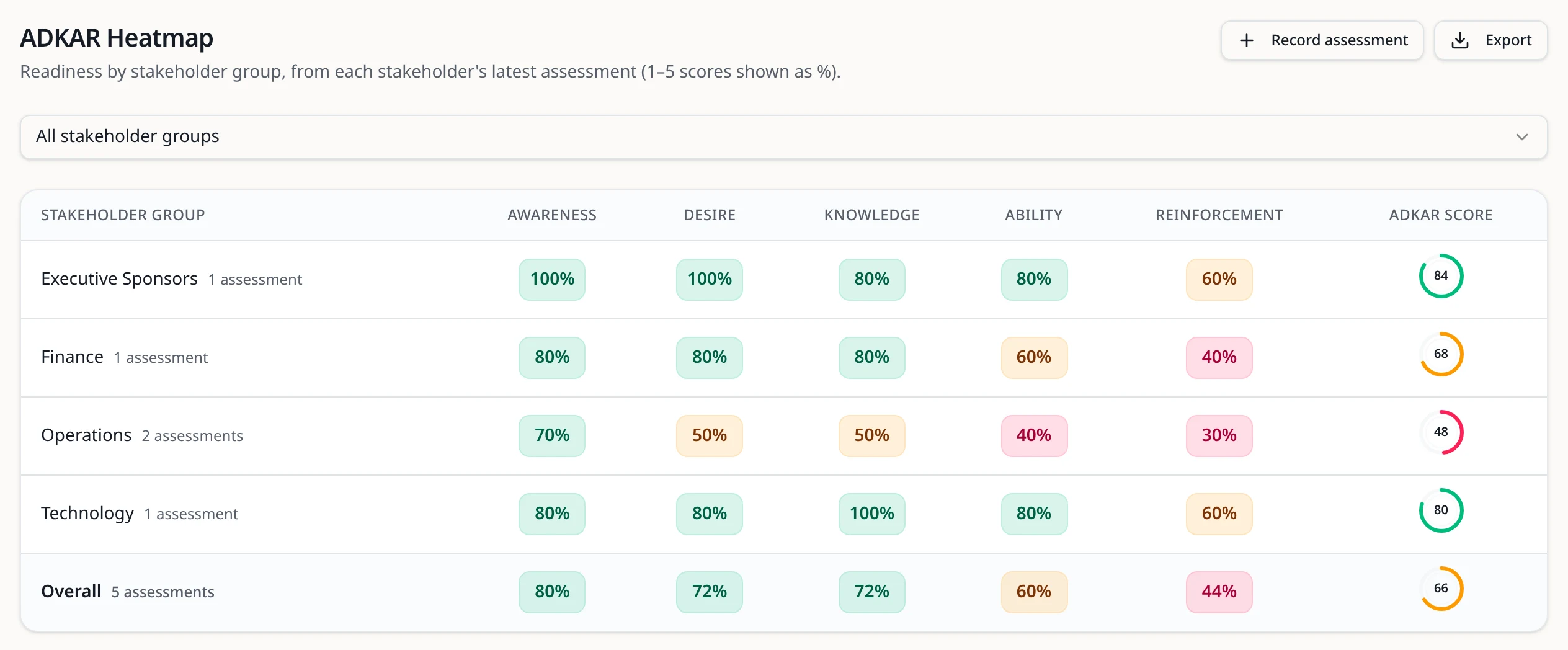
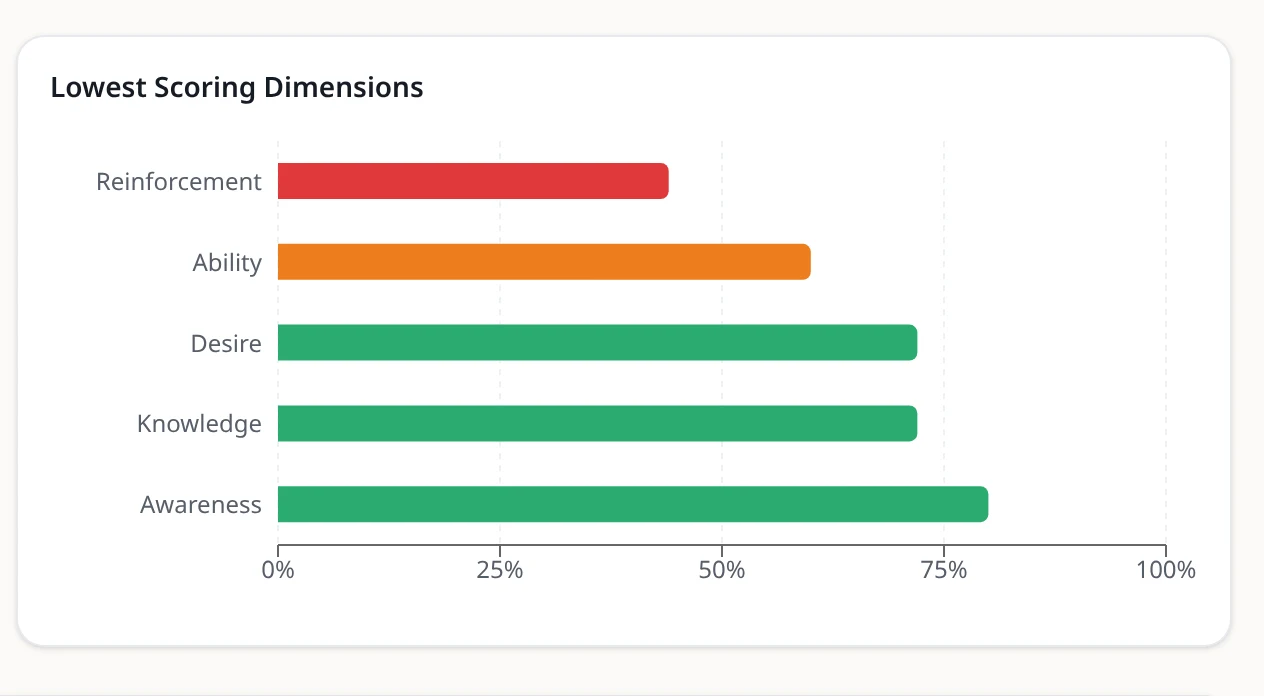
ADKAR scores roll up into a heatmap by stakeholder group with a trend over time, so you can see whether Desire or Ability is the stage holding adoption back, and act before go-live.
In the product
How it works
- 1
Create an initiative
Name the change and, if it supports a client project, link it so the whole project team can work on it.
- 2
Map stakeholders
List the people affected, their group, influence and current support.
- 3
Assess with ADKAR
Score Awareness, Desire, Knowledge, Ability and Reinforcement from 1 to 5 for each stakeholder or for the whole initiative.
- 4
Plan the response
Log resistance, plan training and messages by audience, and schedule rollout waves and roadmap phases.
- 5
Track progress
Follow Kotter's 8 steps for the program and re-assess regularly to see readiness change.
The ADKAR model, in practice
ADKAR breaks individual change into five outcomes: Awareness, Desire, Knowledge, Ability and Reinforcement. Adoption stalls at the first stage that is weak, so training (Knowledge) does little for a group that still lacks Desire.
Scoring each stage for each stakeholder group turns that idea into a map. The lowest-scoring stage per group tells you which intervention to run next: communication for Awareness, sponsorship for Desire, training for Knowledge, coaching and practice for Ability, and recognition for Reinforcement.
Spreadsheets vs. Change Management
| Spreadsheets, decks and shared drives | With PredictiveDeployment | |
|---|---|---|
| Readiness | Gut feel in status meetings | ADKAR scores by stakeholder group, with a trend |
| Stakeholders | A tab nobody updates | Live list with group, influence and support |
| Resistance | Raised in hallways, lost after the meeting | Logged, owned and closed |
| Sharing | One person's file | Shared with everyone on the linked project |
Frequently asked questions
What is the ADKAR model?
ADKAR is a change management model that describes the five outcomes a person needs for a change to stick: Awareness of the need for change, Desire to take part, Knowledge of how to change, Ability to put it into practice, and Reinforcement to sustain it. Measuring each stage shows where adoption is stalling.
What does ADKAR stand for in change management?
Awareness, Desire, Knowledge, Ability and Reinforcement. In PredictiveDeployment you score each stage from 1 to 5 for a stakeholder or the whole initiative, and the heatmap shows readiness by stakeholder group.
What is the difference between ADKAR and Kotter's 8 steps?
ADKAR looks at change from the individual's point of view, while Kotter's 8-step model describes what leaders do at the organizational level, from creating urgency to anchoring the change in the culture. Change Management lets you use both: ADKAR assessments for people and Kotter steps for the program.
How do you measure change readiness?
Record an ADKAR assessment for each key stakeholder at regular intervals. Change Management uses each stakeholder's latest assessment, groups the results by stakeholder group and shows the trend over time, so you can see which group is weakest at which stage.
Can change initiatives be linked to a client project?
Yes. An initiative can be linked to a project, and everyone assigned to that project can then work on it. Without a project link, only the owner and platform admins see it.
Is there a free trial?
Yes — request a 14-day guided pilot from the contact page, with onboarding support and no credit card.